
A night-shift textile cutting assistant position advertised at “competitive salary” in 2026 pays, on average, $16.35 per hour before any shift premium. That number comes straight from ZipRecruiter’s June 2026 data for garment cutting roles across the U.S. The national median hourly wage sits about $12,000 per year higher.
Scroll any job board right now and the listings scream “immediate hiring” and “competitive pay” like these are perks. The phrasing hides what the role demands and what it pays relative to other entry-level manufacturing jobs.

This article is for the person staring at a late-night Indeed listing, wondering if textile cutting is worth the graveyard hours. Maybe it is. But the answer depends on information those postings rarely include.
The $16 Question Nobody Answers in the Job Listing
Textile cutting assistant roles fall under BLS category 51-6062: Textile Cutting Machine Setters, Operators, and Tenders. The classification sounds complicated, but the job itself is straightforward.

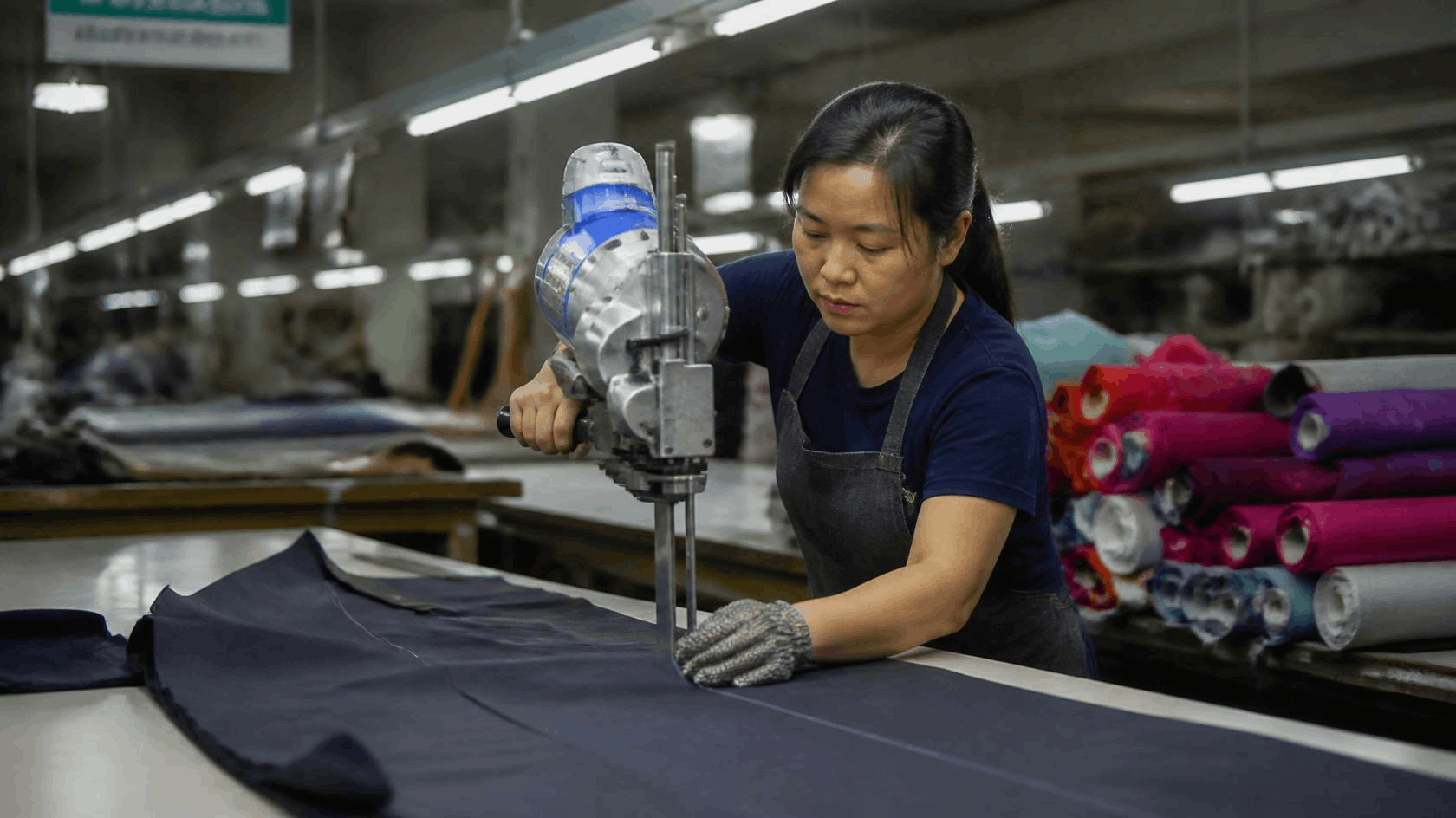
Cut fabric along patterns using manual knives, rotary cutters, or CNC-guided machines. Spread material across long tables. Inspect each cut for accuracy. Keep the machine running.
What “Competitive Salary” Translates To
The wage band for these positions sits tight. According to ZipRecruiter’s 2026 garment cutting data, most workers land between $15.87 and $16.83 per hour. That range barely moves with experience.
A first-week hire and a two-year veteran can be separated by less than a dollar.
I’d argue that when a job listing uses “competitive salary” for a role paying $34,000 a year, the word competitive is doing more marketing work than factual work.
Compare that to a warehouse picker at Amazon or FedEx, where overnight base rates often start at $18 to $20 per hour in 2026. The textile cutting listing suddenly looks less competitive and more desperate.
Night Shift Differential: The Extra $1.85
The night premium is where the math gets interesting, though not in the way the job ads suggest. Manufacturing third-shift premiums averaged $1.85 per hour as a flat-rate add-on in 2025, according to the MRA Industrial & Production Trades Survey.
That figure bumped up from $1.17 in 2021, so the trend line is moving. But $1.85 on top of $16.35 still lands at $18.20 per hour before taxes.
For context, 84% of manufacturing employers now pay shift differentials as flat dollar amounts rather than percentages. So if the posting says “shift differential included,” expect a fixed add-on, not a percentage that scales with raises or overtime.
Why “Immediate Hiring” Tells a Different Story
A textile cutting assistant listing marked “immediate hiring” is almost always signaling something the employer won’t say outright: turnover.
The overnight shift has the highest quit rate in manufacturing. Third-shift workers leave for schedule conflicts, fatigue, and the simple reality that working 10 PM to 6 AM grinds down social routines fast.
Employers know this, and “immediate hiring” keeps the pipeline full.
The Physical Side Nobody Photographs
Job postings show clean factory floors and neat fabric stacks. The lived version includes standing for eight to ten hours straight, lifting fabric rolls up to 35 pounds repeatedly, working around noise from cutting machines, and breathing in fiber dust if ventilation runs below standard.
A cutting assistant’s body takes a specific kind of beating:
- Repetitive wrist and shoulder motion from manual cutting and fabric spreading across tables
- Extended standing on concrete floors, often without anti-fatigue matting
- Exposure to machine noise that may require hearing protection on the overnight shift
These physical demands are listed in fine print on most postings but matter enormously on month three.
Turnover Creates Opportunity (If the Timing Is Right)
The flip side of high turnover is faster advancement. A cutting assistant who stays six months on night shift often gets first crack at machine setter or CNC cutting operator training.
Those positions pay $20 to $22 per hour. Night-shift vacancies at the operator level open more frequently than day shifts because fewer experienced workers want the overnight schedule.
I think the smartest move for someone entering at $16.35 per hour is targeting a facility that runs automated cutting equipment alongside manual stations.
Facilities using Gerber, Lectra, or Eastman CNC cutters offer on-the-job exposure to computer-guided cutting systems. That training, absorbed passively on the job, translates directly into a CNC operator resume line.
Skills That Transfer Out of the Cutting Room
Textile cutting looks like a dead-end job on paper.
The BLS projects employment decline for this category, and the Deloitte manufacturing workforce report from January 2026 flagged apparel as having the fastest payroll decline of any manufacturing subsector: 6.8% average annual drop between 2000 and 2025.
But the hands-on skills gained at the cutting table travel well.
Pattern Reading and CNC Setup
A textile cutting assistant learns to interpret cutting orders, read pattern layouts, and adjust machine settings based on fabric weight, weave, and stretch. Those same skills apply to any CNC operation, from metal fabrication to composite cutting for aerospace.
The O*NET profile for this occupation lists “Computer Numerical Control Cutting Operator” as an official alternate title for the same job code. That detail matters for resume building.
Framing textile cutting experience as CNC operation experience opens doors into industries paying $25 or more per hour.
Quality Inspection and Material Knowledge
Fabric cutting demands constant quality checks: verifying cut dimensions match pattern specifications, spotting material defects before they reach the sewing line, and adjusting blade tension for different textile weights.
These inspection habits translate directly into quality assurance roles across manufacturing.
| Criteria | Textile Cutting Assistant (Night) | Warehouse Associate (Night) | CNC Machine Operator (Night) |
|---|---|---|---|
| Average Hourly Pay | $16.35 + $1.85 differential | $18–$20 base | $22–$26 base |
| Shift Differential | $1–$3 flat | Often built into base | $2–$5 flat |
| Physical Demand | High (standing, lifting, repetitive motion) | High (lifting, walking) | Moderate (machine monitoring) |
| Advancement Path | Cutting operator, CNC operator | Team lead, logistics coordinator | Senior operator, programmer |
| Education Needed | High school diploma or equivalent | High school diploma | Vocational training preferred |
The CNC operator column is the trajectory worth watching.
Applying for Night-Shift Cutting Positions: What Listings Skip
Job postings for textile cutting assistants rarely mention a few things that matter at the application stage.
Background Checks and Drug Screening
Almost every textile manufacturer runs a background check and drug screening. Some, like Tunica-Biloxi Textiles, state this directly.
Others bury it in onboarding paperwork. A positive test result or unresolved background flag typically disqualifies candidates regardless of the “immediate hiring” label.
Staffing Agency vs. Direct Hire
A large portion of night-shift textile cutting jobs run through temp agencies like Surge Staffing. Temp placements come with weekly pay and referral bonuses (Surge offers $400 per referral), but they rarely include benefits until conversion to direct hire.
The timeline for that conversion varies wildly. Some facilities convert at 90 days. Others string temp workers along for a year.
Questions to ask before accepting a temp placement:
- Does the facility have a defined conversion timeline, and what percentage of temps convert?
- Are benefits available during the temp period, or only after direct hire conversion?
- Does the night shift follow a fixed schedule (10 PM to 6 AM) or a rotating 12-hour pattern (6 PM to 6 AM)?
The difference between a fixed eight-hour night shift and a rotating twelve-hour pattern is enormous for sleep, health, and schedule planning.
The Automation Question Hiding Inside Every Cutting Room
Manufacturers face a documented shortage of workers who can operate automated textile equipment. That shortage is the single biggest workforce issue flagged in the Atradius 2026 textile industry outlook. AI-powered machine vision is catching defects in real time. Generative AI creates virtual samples. Predictive tools reduce downtime.
All of this means cutting assistants who learn the automated side of the operation are positioning themselves for roles that are growing, not shrinking.
I’d push back on the idea that textile cutting is a dying trade. The manual, pattern-and-knife version of the job is declining at 6.8% annually. But automated textile cutting is expanding alongside the broader shift toward technical textiles: medical fabrics, protective gear, automotive upholstery, and nonwoven materials. U.S. textile and apparel shipments hit $60.9 billion in 2025. The growth is moving toward specialized products, and those products still need precise cutting.
Questions People Ask About Night-Shift Textile Cutting Assistant Jobs
These are the questions that come up most often when people research this career path.
- Q: Do textile cutting assistants need prior experience?
A high school diploma or GED is the standard requirement. Training happens on the job for most facilities. Having basic math skills and the ability to read pattern specifications gives a slight edge during hiring, but no formal certification is needed at the assistant level. - Q: Is the night shift differential negotiable?
Flat-rate differentials are rarely negotiable for hourly production roles. The rate is usually set company-wide. However, some union contracts push night premiums 1.5 to 2 percentage points above non-union equivalents for the same job code, so checking whether the facility operates under a collective bargaining agreement is worth the effort. - Q: How long does it take to move from cutting assistant to cutting operator?
Timeline depends on the facility, but six months to one year on the night shift is typical. Turnover on overnight schedules creates openings faster than on day shifts. Asking directly about promotion timelines during the interview tells the employer something about long-term intent. - Q: Are textile cutting jobs safe?
The work environment includes machine noise, fiber dust, and repetitive motion risk. OSHA-compliant facilities provide hearing protection and ventilation. Asking about the facility’s injury rate and whether anti-fatigue mats are standard at cutting stations are two questions that reveal more than any job listing will. - Q: Can textile cutting experience lead to jobs outside the textile industry?
Absolutely. CNC cutting, quality inspection, and pattern layout reading transfer into metal fabrication, aerospace composites, and automotive manufacturing. The O*NET database lists CNC Cutting Operator as an official alternate title for the same occupational code.
Conclusion
The $16.35 starting wage for a night-shift textile cutting assistant is below the national manufacturing median. The overnight differential adds roughly $1.85 per hour, landing total compensation near $18.20 before taxes.
The real payoff comes from staying long enough to cross into automated cutting roles paying $22 or more.
Anyone treating this job as a stepping stone rather than a destination should look for facilities running CNC equipment on the night line.